The Invisible Data Trade
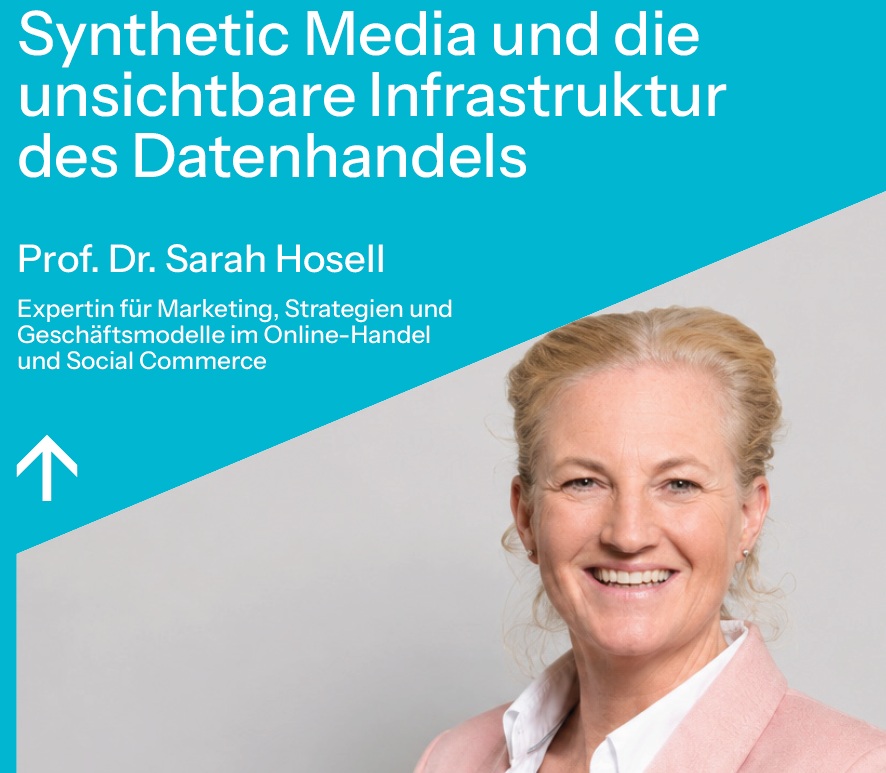
As part of the MU lecture series in the summer semester of 2026, Prof. Dr Sarah Hosell gave a talk on 24 June on hidden networks involving data collection, trade and the platform economy. She provided fascinating insights into the logic of AI and the world of data trading.
The term ‘synthetic media’ refers to digital content such as images, video, audio or text that is generated, either wholly or in part, using artificial intelligence (AI) and algorithms. Such synthetically produced or optimised content serves as a creative pool of ideas for new content or as useful tools; at the same time, however, it also enables new digital business models. And these are based on users disclosing personal data in order to create AI content, which becomes a valuable commodity for providers of generative AI tools. Sarah Hosell, who heads the E-Commerce degree programme at the Institute of Computer Science at Ruhr West University of Applied Sciences, explained that synthetic media solve problems with the help of machine learning and neural networks modelled on the human brain. However, this is not the same as the creativity produced by humans. “AI simulates creativity,” emphasised Sarah Hosell, pointing out that creativity is characterised by situations where problem-solving cannot follow fixed rules or routines, and manifests as “reflective judgement or reason”. This, she said, is a core human competence that AI is incapable of. “A human being can find solutions even with little knowledge; AI cannot,” the expert concluded. However, people with low levels of creativity could use AI to boost their creativity.
Digital auction for personal data
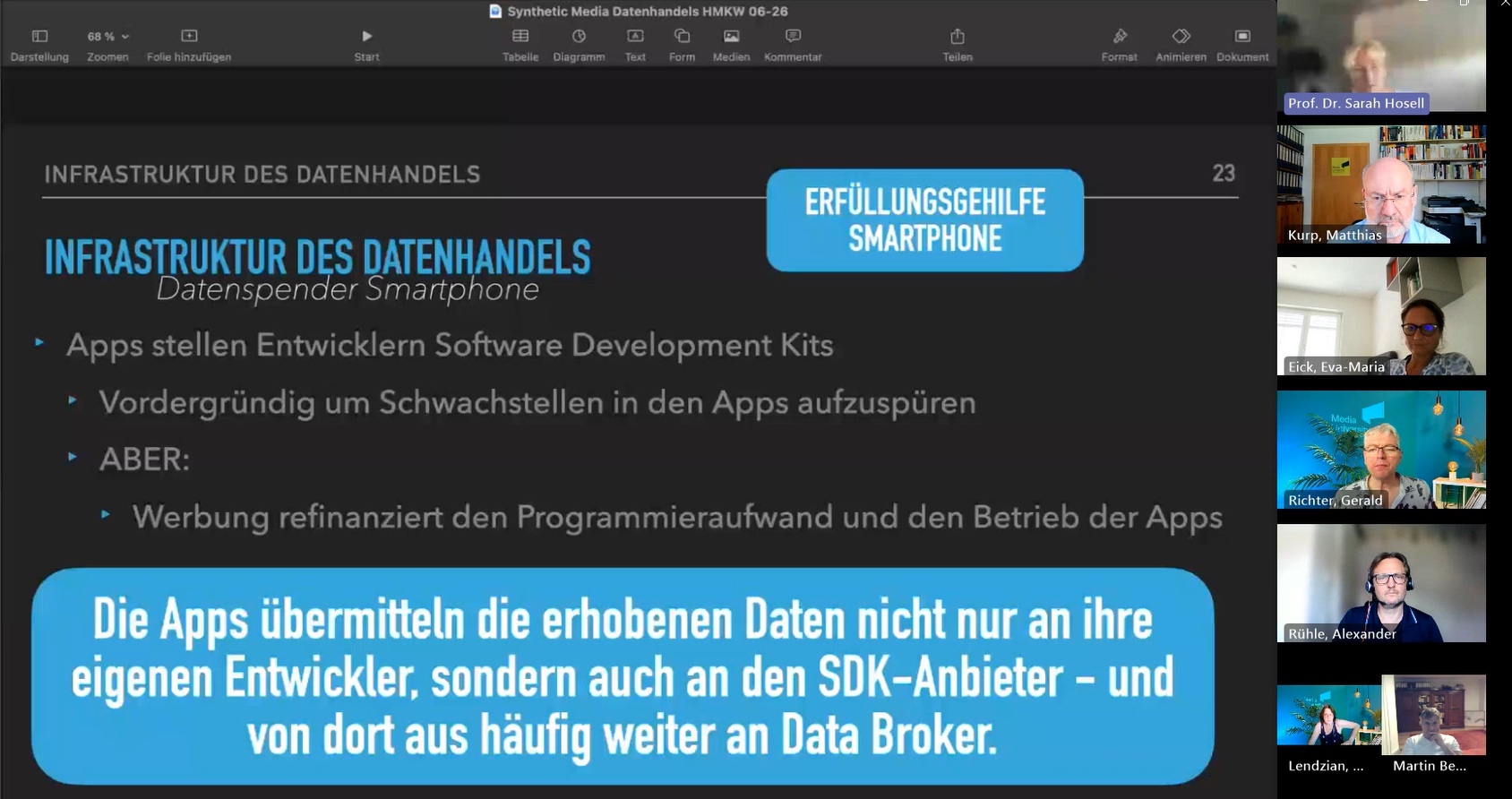
Sarah Hosell explained that, for the media industry, AI is well-suited to boosting efficiency, acting as a ‘creative catalyst’ for interactive storytelling, and also for personalising offers. In this way, advertising content could also be tailored to individual users. When someone visits a website, the website operator lists the advertising space it contains on a supply-side platform (SSP), which forwards the offer via a digital marketplace (ad exchange) to demand-side platforms (DSPs). As part of a digital auction, advertisers would then automatically bid on individual user profiles (real-time bidding) in order to deliver precisely tailored content. Information about location, consumption habits, relationship status, creditworthiness or health data could flow from apps not only to their providers, but also to platform providers or hardware manufacturers. This is made possible by so-called Software Development Kits (SDKs), which are made available by hardware and software manufacturers, as well as platforms, to software developers and programmers so that they can develop digital content. “This is how a smartphone quickly becomes a ‘data donor’,” explained Sarah Hosell. The data collected usually ends up, largely unnoticed, with so-called data brokers.
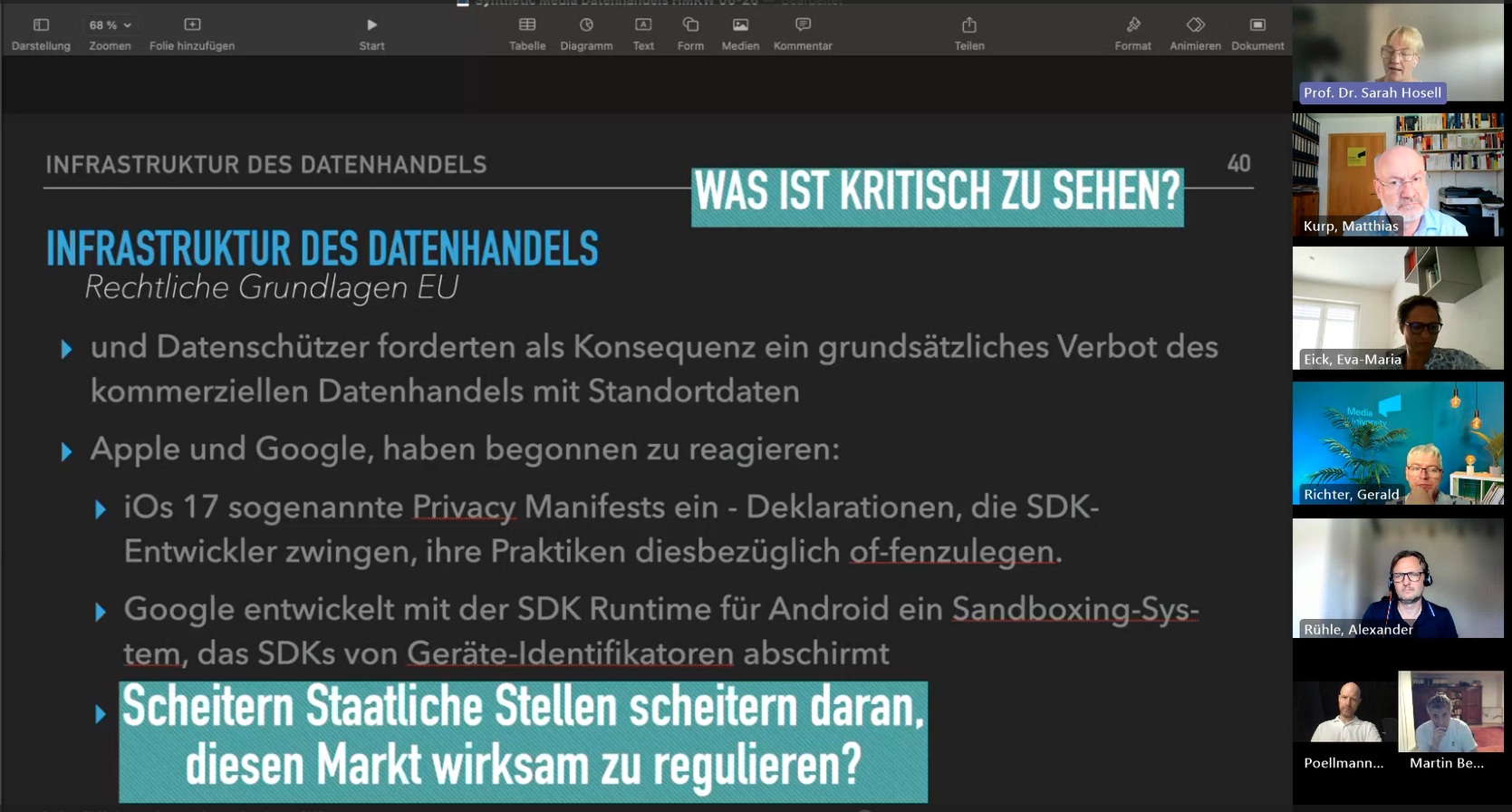
Sarah Hosell, who was a professor at MU (formerly HMKW) from 2015 to 2018, reported that, according to estimates, there are around 4,000 to 5,000 data brokers worldwide. The industry is scarcely regulated by the state, and it is almost impossible to prevent the misuse of data. Anyone who signs up for apps is already providing data profiles. The collection, analysis and evaluation of user data (tracking) takes place in fractions of a second and often ultimately determines the terms on which users are offered specific services or products. More data is leaked from Android smartphones than from Apple’s iOS devices. A combination of tracking and probability calculations ultimately provides information on the likelihood of users purchasing a particular product and how much they are willing to pay for it.

The dilemma of personalisation
Sarah Hosell criticised the fact that data is usually collected without a specific purpose, which she said is not in line with the European General Data Protection Regulation. Her recommendation was that anyone wishing to protect their data should deactivate or delete the so-called advertising ID in their smartphone settings. This would allow apps to continue analysing user behaviour within the app itself, but would make it more difficult to link the data to activities in other apps or on websites. Furthermore, on both Android and iOS devices, the flow of data can be monitored in the data protection or privacy settings. Specialised tools could make this transfer even more transparent or prevent it altogether. However, the expert also made one thing clear: most apps do not work at all, or work less effectively, without personalisation. In the ensuing discussion, it became apparent that the rapid development of agentic AI could soon call the data business into question. If the tracking data collected by brokers no longer comes from humans but from AI, digital traces are practically useless when it comes to personalisation.